
Cross-posted from Watching Those We Chose
We've probably all heard by now of the administration's claim of "authority" to open US Mail addressed to American citizens, without a warrant, based on the "exigent circumstances" associated with the Global War on Terra. And of course we all remember The Great NSA Wiretap Brouhaha from last year.
We now know also that both the CIA and the Defense Department are accessing our personal credit and financial files, again as part of the GWOT.
And we all know that "enemy non-combatants" can be imprisoned, virtually indefinitely, without benefit of any Constitutional rights, and can be tortured by Americans, even if the "enemy" is himself American or one of our few remaining allies.
Now comes news, via the NY Times, that the Defense Dept has also changed their internal regulations on wiretapping Americans, from certification from the Attorney General "issued under the authority of" FISA (Foreign Intelligance Surveillance Act), to "upon attorney general authorization."
This may not seem like much of a difference, but the ten deleted words now leave the DoD free to wiretap Americans without any judicial oversight whatsoever... not even the meagre oversight "provided" by the FISA court (which is, in effect, a Court of Star Chamber for the administration).
Based on the news recently, it appears the administration is concentrating its "homeland security" efforts on building power for the "unitary executive", rather than on the common good.
No one will argue the necessity of properly securing our nation, protecting our citizens and critical infrastructure, and preventing terrorist acts (and, ideally, eliminating the terrorists themselves). I've been in law enforcement and security for the past thirty years; you'll get no argument from me (or any other security professional) that we have to tighten things up, for our own protection.
BUT -- and this is a big "but" -- we cannot do so at the cost of those freedoms which made America, America.
Now that Democrats once again have a say in the workings of government, it is critical that we rein in the abuses of freedom inflicted under the guise of "homeland security." The institutionalized fascism that is the current administration must be brought to heel.
In addition to all the other goals for the 110th Congress, we must urge our Representatives (and Senators) to increase the actual security of our nation -- by hardening or removing targets, by protecting water and food supplies, by strengthening inspections of cargo containers entering our ports -- and at the same time reduce the suppression of honest dissent and the oppression of the American people under spurious claims of "executive privilege", "national security", "homeland security" and "the war on terror."
I hope to be able to present information on "the state of homeland security" -- both as it is and as it should be -- along with how our elected officials plan to balance homeland security and personal freedoms.
Showing posts sorted by relevance for query homeland security. Sort by date Show all posts
Showing posts sorted by relevance for query homeland security. Sort by date Show all posts
Sunday, January 14, 2007

Tuesday, March 21, 2006
TSA Stikes (Out) Again
Part four… this is getting to be like The Hitchhiker’s Guide to the Universe*…
I’ve written – disparagingly – about the TSA in the past. The Transportation Security Administration was formed after the 9-11 terrorist attacks to centralize airline passenger screening under Federal auspices, instead of the then-current system of having each airline contract out its screening operations.
At first, I was in favor of the concept. Having been in the security profession for 25 years, I was well-aware of the realities of airline security. With the much-publicized financial woes of many of the airlines, it was inevitable that “loss-centers” like security would be shorted in favor of federally-mandated programs like maintenance or “profit centers” like maintaining flight frequencies. For most airlines, the purchasing department, not security experts, were in charge of selecting a security contractor to provide screening services. Since the purchasing people usually had little or no knowledge of security (other than having to wear their ID badges at work), it wasn’t surprising that most bids were awarded solely on the basis of cost. The problem is that security services should not be purchased on the basis of the lowest bid: you get what you pay for. If an airline receives bids from two security contractors, one at $15.00 per man-hour and the other at $20.00, the airline would usually go for the $15-an-hour company. Usually, one-half of the per-man-hour cost is the salary for the employee, while the other half is corporate overhead (recruiting, uniforms, background checks, benefits administration, etc.) and profit. This means the winning company pays its employees about $7.50 per hour, while the losing company pays $10.00. Do you think maybe you might get a higher-caliber person for $10 than you would for $7.50?
One of the biggest problems with the contract security industry is that in order to maintain “reasonable” profits, the companies have to minimize expenses… and the expenses that tend to be minimized are salaries for the line officers, training, equipment, and benefits (corporate bigwigs, of course, get excellent salaries and bennies). This, in turn, leads to high employee turn-over. Industry figures I’ve seen indicate a 400% annual turnover in rank-and-file staff. Yes, 400% annually… that means a completely new work force every three months. Of course, it’s not quite that bad – some people leave company A to work for company B, move onto C and so on, but this constant turn-over increases the employer’s costs, which results in even less money available for salaries for the troops. The artificially-low pay scales resulted in two types of employees: part-timers (whose main loyalty, obviously, was to their full-time job, which was usually not security-related) and those who could not get better jobs (like flipping burgers at McDonalds). Either way, the public suffered, even if they didn’t realize it.
Additionally, the lack of standardized training requirements – hell, the lack of any training requirements in many states – led to tremendously unqualified people performing critical functions. Often, screeners would have – at most – an hour or two of training, with just the most basic rudiments of what they were seeing on the screen. The screeners – because of their insufficient training – often could not distinguish between objects that pose a legitimate threat and those that don’t.
That’s why I was so hopeful about TSA in the early days. A Federal takeover of screening would have relieved the airlines of one significant expense (thereby hopefully allowing them to devote that money to maintenance), while at the same time providing screeners with a living wage (originally, the annual wage for entry-level screeners was to be about $40k), and allowing realistic system-wide training standards.
Of course, as is always the case with BushCo initiatives, the idea didn’t quite work out that way. First, the feds cut the pay scales back, almost to the pittance the private-sector screeners were making (about $17K, and try living on that!). Then, the feds removed many employment safeguards, like Civil Service protections, the right to engage in collective bargaining, and so on.
As a result, we have seen several hundred TSA screeners arrested and charged with stealing from airline passengers, both in the security screening lines, and from checked baggage. We’ve seen complaints of other illegal behaviors, including alcohol and drug use at work, harassment, racial profiling, and so on. We’ve seen arrogance coupled with incompetence, and stupidity coupled with authority.
Now, the GAO – Government Accountability Office – has compiled a classified report showing that federal investigators were able to carry bomb-making materials past screeners at 21 airports. Even when investigators deliberately triggered extra screening precautions, no one discovered the materials.
Recipes for homemade bombs are readily available on the Internet, and the ingredients are all available over the counter, so it’s not like this is some far-fetched scenario.
With the advent of hardened cockpit doors, and (admittedly) half-assed screening at check-in, experts say that explosives are now the biggest threat from terrorists targeting airliners.
But the screeners can’t spot the materials, even in extra-scrutiny situations. Yet these are the same people who can find a pair of toenail clippers in a woman’s carry-on suitcase.
Security expert Bruce Schneier, whom I’ve quoted before, points out that TSA and its parent agency, the Department of Homeland Security, spend most of their time “preparing for the last attack”: after 9-11, all emphasis was on aircraft security; after the Madrid and London bombings, emphasis shifted to commuter transit.
For some bizarre reason, TSA and DHS seem to be unable to think outside the box; they’ve expressed little interest in securing segments of the critical infrastructure that have not yet been attacked, but that have obvious and well-publicized security short-comings, like chemical and power plants. Nor has there been a concerted effort to prepare for a possible (or, some say, inevitable) bird flu outbreak, other than the Department of Health and Human Services advising Americans to stockpile canned tuna and powdered milk (the “duct tape and plastic sheeting” school of emergency preparedness). And of course we all know how well another DHS component, FEMA, fared in responding to Hurricane Katrina.
Part of the problem with DHS is the tendency to concentrate on the “sexier” parts of their mandate, like terrorism, and neglect the more mundane aspects like disaster preparedness. It is this misplaced emphasis that eliminated FEMA as a separate Cabinet-level agency, that gutted the training and preparedness activities, and directly resulted in such fiascos as Katrina.
The same misplaced emphasis has resulted in allegedly professional screeners who needlessly risk our lives and who can’t successfully perform their job functions.
___
* For those who aren't familiar with the series, it is a five-volume comedic/science fiction trilogy by the late Douglas Adams.
I’ve written – disparagingly – about the TSA in the past. The Transportation Security Administration was formed after the 9-11 terrorist attacks to centralize airline passenger screening under Federal auspices, instead of the then-current system of having each airline contract out its screening operations.
At first, I was in favor of the concept. Having been in the security profession for 25 years, I was well-aware of the realities of airline security. With the much-publicized financial woes of many of the airlines, it was inevitable that “loss-centers” like security would be shorted in favor of federally-mandated programs like maintenance or “profit centers” like maintaining flight frequencies. For most airlines, the purchasing department, not security experts, were in charge of selecting a security contractor to provide screening services. Since the purchasing people usually had little or no knowledge of security (other than having to wear their ID badges at work), it wasn’t surprising that most bids were awarded solely on the basis of cost. The problem is that security services should not be purchased on the basis of the lowest bid: you get what you pay for. If an airline receives bids from two security contractors, one at $15.00 per man-hour and the other at $20.00, the airline would usually go for the $15-an-hour company. Usually, one-half of the per-man-hour cost is the salary for the employee, while the other half is corporate overhead (recruiting, uniforms, background checks, benefits administration, etc.) and profit. This means the winning company pays its employees about $7.50 per hour, while the losing company pays $10.00. Do you think maybe you might get a higher-caliber person for $10 than you would for $7.50?
One of the biggest problems with the contract security industry is that in order to maintain “reasonable” profits, the companies have to minimize expenses… and the expenses that tend to be minimized are salaries for the line officers, training, equipment, and benefits (corporate bigwigs, of course, get excellent salaries and bennies). This, in turn, leads to high employee turn-over. Industry figures I’ve seen indicate a 400% annual turnover in rank-and-file staff. Yes, 400% annually… that means a completely new work force every three months. Of course, it’s not quite that bad – some people leave company A to work for company B, move onto C and so on, but this constant turn-over increases the employer’s costs, which results in even less money available for salaries for the troops. The artificially-low pay scales resulted in two types of employees: part-timers (whose main loyalty, obviously, was to their full-time job, which was usually not security-related) and those who could not get better jobs (like flipping burgers at McDonalds). Either way, the public suffered, even if they didn’t realize it.
Additionally, the lack of standardized training requirements – hell, the lack of any training requirements in many states – led to tremendously unqualified people performing critical functions. Often, screeners would have – at most – an hour or two of training, with just the most basic rudiments of what they were seeing on the screen. The screeners – because of their insufficient training – often could not distinguish between objects that pose a legitimate threat and those that don’t.
That’s why I was so hopeful about TSA in the early days. A Federal takeover of screening would have relieved the airlines of one significant expense (thereby hopefully allowing them to devote that money to maintenance), while at the same time providing screeners with a living wage (originally, the annual wage for entry-level screeners was to be about $40k), and allowing realistic system-wide training standards.
Of course, as is always the case with BushCo initiatives, the idea didn’t quite work out that way. First, the feds cut the pay scales back, almost to the pittance the private-sector screeners were making (about $17K, and try living on that!). Then, the feds removed many employment safeguards, like Civil Service protections, the right to engage in collective bargaining, and so on.
As a result, we have seen several hundred TSA screeners arrested and charged with stealing from airline passengers, both in the security screening lines, and from checked baggage. We’ve seen complaints of other illegal behaviors, including alcohol and drug use at work, harassment, racial profiling, and so on. We’ve seen arrogance coupled with incompetence, and stupidity coupled with authority.
Now, the GAO – Government Accountability Office – has compiled a classified report showing that federal investigators were able to carry bomb-making materials past screeners at 21 airports. Even when investigators deliberately triggered extra screening precautions, no one discovered the materials.
Recipes for homemade bombs are readily available on the Internet, and the ingredients are all available over the counter, so it’s not like this is some far-fetched scenario.
With the advent of hardened cockpit doors, and (admittedly) half-assed screening at check-in, experts say that explosives are now the biggest threat from terrorists targeting airliners.
But the screeners can’t spot the materials, even in extra-scrutiny situations. Yet these are the same people who can find a pair of toenail clippers in a woman’s carry-on suitcase.
Security expert Bruce Schneier, whom I’ve quoted before, points out that TSA and its parent agency, the Department of Homeland Security, spend most of their time “preparing for the last attack”: after 9-11, all emphasis was on aircraft security; after the Madrid and London bombings, emphasis shifted to commuter transit.
For some bizarre reason, TSA and DHS seem to be unable to think outside the box; they’ve expressed little interest in securing segments of the critical infrastructure that have not yet been attacked, but that have obvious and well-publicized security short-comings, like chemical and power plants. Nor has there been a concerted effort to prepare for a possible (or, some say, inevitable) bird flu outbreak, other than the Department of Health and Human Services advising Americans to stockpile canned tuna and powdered milk (the “duct tape and plastic sheeting” school of emergency preparedness). And of course we all know how well another DHS component, FEMA, fared in responding to Hurricane Katrina.
Part of the problem with DHS is the tendency to concentrate on the “sexier” parts of their mandate, like terrorism, and neglect the more mundane aspects like disaster preparedness. It is this misplaced emphasis that eliminated FEMA as a separate Cabinet-level agency, that gutted the training and preparedness activities, and directly resulted in such fiascos as Katrina.
The same misplaced emphasis has resulted in allegedly professional screeners who needlessly risk our lives and who can’t successfully perform their job functions.
___
* For those who aren't familiar with the series, it is a five-volume comedic/science fiction trilogy by the late Douglas Adams.
Thursday, November 30, 2006
Emergency Preparedness - Part Two
[Update: Fixed some formatting and spelling errors, and deleted a duplicate post}
In Part One, we examined a very good article by Dr. Eric Taylor and his take on the FEMA emergency preparedness manual. In Dr. Taylor's view, the manual falls short in many critical areas. In this part, we'll take a look at what other emergency response professional think of our state of preparedness.
James M. Shannon, president of the National Fire Protection Association, writing in the current issue of the NFPA Journal, has this to say about preparedness as it affects the fire service:
Shannon is reporting on a recent study completed by NFPA for the U.S. Fire Administration, which is part of FEMA. Here are some of the points he makes: [All emphasis added]
Phillips also notes how the costs associated with exercises have skyrocketed: TOPOFF1 ("Top Officials", the granddaddy of all exercise programs), in 2000, cost $3 million, 2005's TOPOFF3 cost $12 million.
In Part One, we examined a very good article by Dr. Eric Taylor and his take on the FEMA emergency preparedness manual. In Dr. Taylor's view, the manual falls short in many critical areas. In this part, we'll take a look at what other emergency response professional think of our state of preparedness.
James M. Shannon, president of the National Fire Protection Association, writing in the current issue of the NFPA Journal, has this to say about preparedness as it affects the fire service:
Let me be blunt. Most American communities were not prepared to cope with a homeland security event when 9/11/2001 occurred. Most are not prepared now. And most will not be prepared in the future at the pace we are moving.
Shannon is reporting on a recent study completed by NFPA for the U.S. Fire Administration, which is part of FEMA. Here are some of the points he makes: [All emphasis added]
For instance, there was some improvement in planning by fire departments to coordinate the use of outside personnel and equipment in a homeland security response for a wildfire or terrorist attack. But the study found that most departments still do not have written plans for these kinds of incidents.There has been some progress made in providing SCBA [Self-Contained Breathing Apparatus, or "Scott Packs"] and PASS [Personal Alert Safety System, which emits an ear-splitting tone of a firefighter does not move for a predetermined period of time - ie, if he's unconscious or trapped, - which assists other firefighters in finding their fallen comrade] devices. But even after all of the attention that has been paid to improving preparedness, 60 percent of departments do not have enough SCBAs and 48 percent do not have enough PASS devices to equip everyone on a shift.
The number of firefighters with insufficient training or certification has declined, but even for something as fundamental and near-universal as structural firefighting, more than half of departments still do not have all involved firefighters formally trained.
Overall, in area after area, the second needs assessment shows that there has been little or no progress, not because the grants program has been misdirected or ineffective but because the needs are so great relative to the size of the program.
How does this affect the preparedness efforts we as citizens must make? If the fire service -- for whatever reason -- is unable to respond in the event of a major emergency, we are on our own.
This is why it is so critical for all citizens to have at least a few fire extinguishers around the house, and the knowledge of how and when to use them... and more importantly, when not to use them and get the hell out instead. Your local fire department can supply a huge amount of useful information (and maybe even training) in home fire safety, as can NFPA and USFA.
GovExec.com reporter Zack Phillips wrote about emergency preparedness exercises, and how they may tend to provide artifically rosy results. Beginning with FEMA's now-infamous "Hurricane Pam" exercise in 2004, Phillips examines the strong and weak points of drills and exercises and cites Michael J. Hopmeier, who:
...points to the example in September of joy-riding teenagers driving past the guard posts at the Miami military base that houses U.S. Central Command, and a retired police officer using fake identification who entered Homeland Security Department headquarters in June. "When it wasn't a test, when it wasn't the [inspector general] going through, when it wasn't an assessment; when it was a real-world event, it turned out the security failed," he says. [Emphasis added]
Phillips also notes how the costs associated with exercises have skyrocketed: TOPOFF1 ("Top Officials", the granddaddy of all exercise programs), in 2000, cost $3 million, 2005's TOPOFF3 cost $12 million.
Phillips goes on to point out the effects of pre-planning in an exercise: the advance notice to participants may result in overly-prepared responses, rather than the spur-of-the-moment actions that actually occur:
"If you know there's going to be a test of everything, then you've already bought the answer, or you've excluded a lot of the problems," says William Bicknell, a professor at Boston University's School of Public Health and a former Massachusetts public health director.
Its similar to knowing there is going to be a fire drill at work at 9:30 AM on Thursday: you're going to keep your coat handy, you'll make sure you're not on the phone, and so on. Yet, in a real fire, smoke may obscure the path to an exit, especially if you're forced to use an exit other than your normal one. In some ways, a drill or other emergency exercise presents a "best-case" scenario, rather than the "worst-case" that always seems to develop in a legitimate emergency.
Phillips' conclusion appears to be that exercises do offer concrete opportunities for improvement, but there are some deficiencies that need to be rectified to achieve full value from the programs.
Thursday, December 28, 2006
Round-Up, Part I
My, oh my, what a long, strange week it's been...
First, at least in terms of priority, we lost three more greats: James Brown, President Gerald R. Ford, and former CBS executive Dr. Frank Stanton.
Then, of course, we had the usual Christmas/Kwanzaa/Hanukah/Festivus insanity, including the obligatory near-riots at several malls. Unfortunately, we also saw yet another fatal shooting rampage, also at a mall.
On the Homeland Insecurity front, a baby was sent through an X-ray machine at LAX. Fortunately, the TSA screener spotted the baby before he receieved an excessive dose of radioation. I suppose a baby's skeleton must look like a pair of toenail scissors in an X-ray.
Also on the TSA front, TSA has announced that airport workers will now be screened upon reporting for work. Mark Hatfield, the Federal Security Director at Newark Liberty Airport outside NYC, said, "it's not because we have suspicions about the employees, but we know they represent a body of people that terrorists can hide among." The screening, of course, will not apply to TSA staff, as they are -- apparently -- inherently trustworthy, despite the agency's record of hiring and retaining perverts, criminals and assorted losers (here and here, plus you can Google "TSA screeners arrested", which now yields 90,500 hits).
TSA's assumption of inherent honesty is tarnished somewhat by an incident in San Antonio, in which a man found a TSA screener's jacket for sale in a local thrift store. After TSA blew the guy off, he went to the local TV station with the story. Turns out, the TSA has at least 3719 missing uniforms and/or employee ID's.
Now bear with me on this...
Your average airport probably has at least 100 screeners (places like JFK, O'Hare, and LAX have more than 1000), who work various full- and part-time shifts. Because of TSA's treatment of the screeners, there is constant turn-over in the workforce, so it's entirely likely that not even the supervisors will recognize each and every person; therefore, they have to rely on uniforms and employee ID's. 3719 missing unforms and ID's means there's an excellent chance that some miscreant will get his/her/its hands on one and cause some trouble.
TSA's response? [Emphasis added]
Martinez is the man who found the jacket for sale.
Oh, and TSA lied to Congress about the problem: [Emphasis added]
Yup, that's "inherent honesty" for you.
The Department of Homeland Security announced a couple of weeks ago that they were implementing new procedures to increase security in the shipping sector, which includes ports and railroads. In response, both the United States Department of Transportation and the Port Authority of New York and New Jersey revealed their own plans, which of course provide much better security than DHS's offering.
Gotta love 'em.
First, at least in terms of priority, we lost three more greats: James Brown, President Gerald R. Ford, and former CBS executive Dr. Frank Stanton.
Then, of course, we had the usual Christmas/Kwanzaa/Hanukah/Festivus insanity, including the obligatory near-riots at several malls. Unfortunately, we also saw yet another fatal shooting rampage, also at a mall.
On the Homeland Insecurity front, a baby was sent through an X-ray machine at LAX. Fortunately, the TSA screener spotted the baby before he receieved an excessive dose of radioation. I suppose a baby's skeleton must look like a pair of toenail scissors in an X-ray.
Also on the TSA front, TSA has announced that airport workers will now be screened upon reporting for work. Mark Hatfield, the Federal Security Director at Newark Liberty Airport outside NYC, said, "it's not because we have suspicions about the employees, but we know they represent a body of people that terrorists can hide among." The screening, of course, will not apply to TSA staff, as they are -- apparently -- inherently trustworthy, despite the agency's record of hiring and retaining perverts, criminals and assorted losers (here and here, plus you can Google "TSA screeners arrested", which now yields 90,500 hits).
TSA's assumption of inherent honesty is tarnished somewhat by an incident in San Antonio, in which a man found a TSA screener's jacket for sale in a local thrift store. After TSA blew the guy off, he went to the local TV station with the story. Turns out, the TSA has at least 3719 missing uniforms and/or employee ID's.
Now bear with me on this...
Your average airport probably has at least 100 screeners (places like JFK, O'Hare, and LAX have more than 1000), who work various full- and part-time shifts. Because of TSA's treatment of the screeners, there is constant turn-over in the workforce, so it's entirely likely that not even the supervisors will recognize each and every person; therefore, they have to rely on uniforms and employee ID's. 3719 missing unforms and ID's means there's an excellent chance that some miscreant will get his/her/its hands on one and cause some trouble.
TSA's response? [Emphasis added]
"Yes I did," Martinez told News 4 during an on-camera interview. "When I first got the jacket, I looked in the phone book and I tried to contact somebody over at TSA. And I told them about the jacket, and they just told me it was a discarded uniform, and that was it. I didn't feel comfortable, but I didn't throw it away or give it away." Martinez said the TSA told him they didn't want it back.
Martinez is the man who found the jacket for sale.
Oh, and TSA lied to Congress about the problem: [Emphasis added]
Congressman Lamar Smith spoke with the Trouble Shooters about the problem during a recent visit to his office on the North Side of San Antonio. Smith sits on the Homeland Security Committee and did not know the problem was getting worse until we showed him the new information. That's because TSA sent him a letter in August claiming the numbers were much lower. In that letter, Assistant Secretary Kip Hawley told the Congressman that TSA did not have any idea of the number of missing uniforms and that only 1375 ID badges were reported missing. That's not true. TSA had the larger numbers in May, nearly four months before they sent the letter to Smith.
Yup, that's "inherent honesty" for you.
The Department of Homeland Security announced a couple of weeks ago that they were implementing new procedures to increase security in the shipping sector, which includes ports and railroads. In response, both the United States Department of Transportation and the Port Authority of New York and New Jersey revealed their own plans, which of course provide much better security than DHS's offering.
Gotta love 'em.
Friday, October 19, 2007
TSA Laptops Stolen... Along With Hazmat Driver Info
Transportation SECURITY Administration, which is part of the Department of Homeland SECURITY…
Yup, makes me REAL confident in their ability to safeguard our security.
Now, what part of SECURITY do these MO-rons not understand?"TSA Laptops With Hazmat Driver Info Stolen"
Dark Reading (10/16/07) ; Higgins, Kelly JacksonThe Transportation Security Administration has experienced a security breach involving stolen laptops from a TSA contractor containing sensitive information about hazardous material commercial drivers. Two laptops, belonging to Integrated Biometric Technology, contained Social Security numbers, driver's license numbers, and names of about 4,000 hazmat drivers. Information regarding the presence of drivers' personal data was obfuscated by two separate accounts from TSA, first stating they had erased all sensitive information on one laptop, then confessing the data was still present on both laptops. Although the TSA ordered all contractor information to be encrypted following the breach, Paul Kocher of Cryptography Research says the agency enacted "basic measures" only after a disaster occurred. A previous incident involving a missing external storage device left 100,000 TSA employees' bank accounts, payroll information, and Social Security numbers exposed. Security experts say they would not be surprised by terrorists attempting to attack the agency because of their failure to adhere to security best practices, such as deleting or encrypting sensitive data. Integrated Biometric Technology will provide those exposed by the breach with one year of free credit-report monitoring. [Emphasis added]
Yup, makes me REAL confident in their ability to safeguard our security.
Wednesday, February 09, 2005
Odds 'n' Ends
State of the State (Michigan)
I heard some of Gov. Jennifer Granholm's State of the State address last night (courtesy of the local university/NPR affiliate, of course). She made some interesting proposals regarding Michigan's future, in terms of employment, technology, and education. To me, the most interesting proposal was what she termed "college credit amnesty", in which Michigan's colleges and universities would accept virtually all college credits, regardless of age. To someone like me -- a proud member of the 30-year-plan community -- that's really good news. I hope the programs she discussed last night are all passed.
I did not listen to the rebuttal by the mouth-breathers.
_____
From Kevin Drum:
Kevin, it comes from experience. It comes from hearing the same tired old lame excuses from the campaignistration time after time after time after time.....
_____
Best Name of the Year (So Far):
Bush's trips promoting his Social Security privatization/personalization/overhaul/dismantling:
_____
From Atrios:
I don't know why anybody would be surprised. After TSA -- which was the first 'agency' designated to become a part of the Ministry of Homeland Security -- exempted its employees (and hence itself) from various troublesome laws like collective bargaining, it should have been obvious what was coming.
Another disturbing thing about the Ministry is the fact that it's broken into "directorates"... like the old KGB. Not to mention that "Homeland" is awfully close to "Fatherland" (Nazi Germany) and "Motherland" (Russia and the USSR) for my liking.
(Gawd, if I'm not careful, I'm gonna wind up 'disappeared'...)
* A propos of nothing, I found a great bumper sticker before the election: "Librarians for Laura: Because One Reader in the Family is Enough".
I heard some of Gov. Jennifer Granholm's State of the State address last night (courtesy of the local university/NPR affiliate, of course). She made some interesting proposals regarding Michigan's future, in terms of employment, technology, and education. To me, the most interesting proposal was what she termed "college credit amnesty", in which Michigan's colleges and universities would accept virtually all college credits, regardless of age. To someone like me -- a proud member of the 30-year-plan community -- that's really good news. I hope the programs she discussed last night are all passed.
I did not listen to the rebuttal by the mouth-breathers.
_____
From Kevin Drum:
BUDGET MAGIC....Imagine that. The administration's prescription drug bill isn't going to cost $400 billion, and it's not going to cost $534 billion. It's going to cost $1.2 trillion.
But it's not so bad. Honest. The White House says there are offsets that will make the real cost $720 billion, a mere doubling of the original estimate. Personally, my guess is that these "offsets" will turn out to be less than the White House is saying, but you know me. I have an irrational hatred of George Bush that causes me to distrust his numbers. I don't know where it comes from.
Kevin, it comes from experience. It comes from hearing the same tired old lame excuses from the campaignistration time after time after time after time.....
As Matt Yglesias points out, the worst part of this whole charade is being forced to listen to congressional Republicans who pretend that they're outraged at being duped. The clarification about costs (that is, today's clarification, not last year's) has a simple source: the White House is now using the first ten years that the prescription drug program actually exists (2006-2015) instead of the first ten years after the bill passed (2004-2013) — which included a couple of years in which the program wasn't even scheduled to exist.In other words, once again, the Bush Cartel is lying. That is what they do. They are constitutionally incapable of telling the truth. In Rape of the A.P.E., Allen Sherman (the one who did "Camp Grenada") points out that 'lies are more valuable than truth'. Obviously, that may well be the only book Shrub has ever read (or had read to him at bedtime).*
This is childish, and no one can pretend to be astonished about tactics like this, especially since Republicans routinely use them on other programs as well. Dick Cheney, for example, uses estimates for the cost of Social Security privatization based on ten years starting right now, even though the program won't start up until 2009 at the earliest. The real number is at least 50% higher than the White House estimate, and everyone knows it.Repeat after me: They are lying. They are lying. They are lying!
Tax cuts are treated the same way. Two years ago, for example, Republican Senator George Voinovich loudly insisted that Bush's 2003 tax cut be limited to $350 billion. How responsible! But the deal he cut only got to $350 billion by pretending that the cuts would be temporary, thus cutting their apparent 10-year cost. Everyone knew perfectly well that Bush would turn around and fight to make the cuts permanent, and that's exactly what happened. Voinovich knew it too.The constituents will never wake up. If they did, they would realize that all the rosy promises coming out of Twig's smirking little face were nothing but the baldest of lies. The neocon wingnut mouth-breathers couldn't handle that.
The Bush White House is congenitally unable to produce honest figures for any of its programs, and the sleight of hand it uses is transparent to everyone. But Republicans pretend to accept it anyway and then pretend further to be shocked when the real numbers eventually can't be concealed any longer. I wonder if their constituents will ever wake up?
_____
Best Name of the Year (So Far):
Bush's trips promoting his Social Security privatization/personalization/overhaul/dismantling:
Bamboozlepalooza TourCoined by (to the best of my knowledge) Josh Marshall at Talking Points Memo.
_____
From Atrios:
Above the Law
So, Republicans want to give the Secretary of Homeland Security the power to exempt itself and its contractors from all laws.
Can we hear a big "Indeed! Heh!"
Thanks.
...The Raw Story has more.
I don't know why anybody would be surprised. After TSA -- which was the first 'agency' designated to become a part of the Ministry of Homeland Security -- exempted its employees (and hence itself) from various troublesome laws like collective bargaining, it should have been obvious what was coming.
Another disturbing thing about the Ministry is the fact that it's broken into "directorates"... like the old KGB. Not to mention that "Homeland" is awfully close to "Fatherland" (Nazi Germany) and "Motherland" (Russia and the USSR) for my liking.
(Gawd, if I'm not careful, I'm gonna wind up 'disappeared'...)
* A propos of nothing, I found a great bumper sticker before the election: "Librarians for Laura: Because One Reader in the Family is Enough".
Sunday, November 19, 2006
WMDs and Railroads
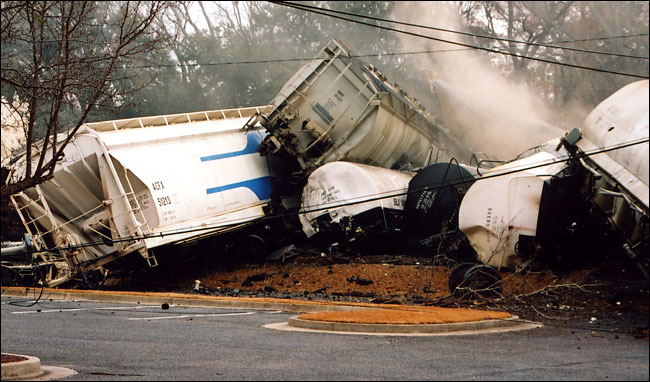 In an article in the October issue of Homeland Protection Professional (no link, paid subscription), Technology Writer Douglas Page discusses the January 6, 2005, train derailment in Graniteville, SC. The train was carrying deadly chlorine gas, sodium hydroxide and creosol. One chlorine car ruptured, spewing 90 tons of gas into the atmosphere. Nine died, hundreds were injured, and more than 5000 people were evacuated (many could not return home for two weeks). Page notes that approximately 13 million tons of chlorine was produced in 2004, with most of it shipped by rail.
What does a tragic rail accident have to do with Weapons of Mass Destruction?
What if, instead of derailing in a small South Carolina town at 2:40am, the train had derailed at 3:30pm? What if it happened in Washington, DC, where tracks run less than five blocks from the US Capitol and the National Mall? In the autumn, with the Mall crowded with tourists?

What could happen is this:
- 100,000 people could be killed or injured in the first 30 minutes.
- People could die at the rate of 100 per SECOND.
- A cloud of toxic gas 10 miles wide and 40 miles long could be produced
You think maybe a terrorist might consider that scenario worth considering? Remember, fewer than 3,000 died in NYC on 9-11.
I've been bitching about chemical security for a while. Back in August, I wrote:
Force the chemical and energy industries off their collective asses and start making some serious progress in securing their respective facilities. [snip] Chemical security is a joke: recent articles in the NY Times, for instance, showed open, unmanned gates into freight yards handling hazardous loads.
I'm not the only one, of course. Just about every safety and security person outside of DHS has been screaming about how tempting these targets would be.
The Emergency Response Guide, a cooperative effort of the US Dept of Transportation, Mexico's Secretariat of Transport and Communications, and Canada's Transport Canada, indicates a minimum exclusion area of 100 meters (330 feet) in all directions for most unknown spills. If the spill involves a tank, rail car, or tank truck, the minimum is 800 meters (1/2 mile). The Graniteville chlorine leak required an exclusion zone of one mile.
Just for the hell of it, here are some minimum evacuation distances from the ERG:
- Chlorine: 0.8 mile
- Phosgene: 2.6 miles (phosgene is an ingredient in methyl isocyanate)
- Cyanogen chloride: 1.5 miles
- Pentaborane: 2.1 miles
- Liquified gas, flammable, poisonous: 3.2 miles
How close are you to a rail line?
The Department of Homeland Security, of course, is still too busy planning for the last attack to worry about the next attack. The chemical industry sure isn't going to volunteer to implement security procedures on their own: keeping things safe costs money, which could otherwise be put to "better" uses... like stock options, dividends, and executive pay packages.
The industry doesn't even really learn from its own mistakes, either: after Bhopal, Union Carbide did the absolute bare minimum in upgrades in its West Virginia plant (which produced the same methyl isocyanate as the Bhopal plant). Then they sold off the Indian subsidiary that ran the Bhopal plant, claiming that the management in Bhopal had not followed corporate guidelines. [Note: for a really in-depth look at how Union Carbide botched Bhopal, as well as detailed discussions of the Three Mile Island disaster, and two well-handled crises -- Rely tampons and the Tylenol poisonings -- see Steven Fink's Crisis Management: Planning for the Inevitable.)
And Lord knows we can't rely on the Bush administration to protect us. The current crop of politicians (at least until January) is too deep in the pockets of their corporate sponsors to do anything that would reduce profits. Why do you think the Feds are so enamoured of duct tape?
The problems aren't restricted to chlorine, either. There are plenty of other hazardous materials running around the country: anhydrous ammonia (used in commercial cooling systems), propane, gasoline, fuel oil. In fact, the ERG has 70 pages of listings by chemical name... in about 6-point type (about 50 listings per page, or roughly 3500 altogether).
One in six trucks carries some sort of hazardous material.
Okay, this piece isn't going to give you the "warm fuzzies". It's not supposed to. It's supposed to wake you up so you can lean on your Congresscritters to improve our security.
Sunday, July 07, 2019
I was going through some on-line FEMA training, and ran across this little gem on disaster response:
Maybe I'm overly-paranoid when it comes to der trumpenfuhrer, but I can see him and his playmates declaring a "national emergency" that would "require" suspension of the Constitution.
1. IS-830, Introduction to NRF Incident Annexes, https://training.fema.gov/is/courseoverview.aspx?code=IS-830, retrieved 07-07-19
Where State, tribal, or local governments are unable to establish or maintain an effective incident command structure due to catastrophic conditions, the Federal Government, at the direction of the Secretary of Homeland Security, may establish a unified command structure, led by the Unified Coordination Group (UCG), to save lives, protect property, maintain operation of critical infrastructure/key resources (CIKR), contain the event, and protect national security. The Federal Government shall transition to its role of coordinating and supporting the State, tribal, or local government when they are capable of reestablishing their incident command.1This would be the same Department of Homeland Security that is currently running American concentration camps, demanding papers from citizens with dark skins, and arresting Americans for leaving water in the desert for people seeking a new life in the "land of the free [hah] and the home of the draft dod-- err, brave." The same DHS that has ALL the Federal law enforcement except the FBI. The same DHS whose CBP goons were sharing viciously racist posts on at least one FB group, and whose management investigated those posts... and did nothing.
Maybe I'm overly-paranoid when it comes to der trumpenfuhrer, but I can see him and his playmates declaring a "national emergency" that would "require" suspension of the Constitution.
1. IS-830, Introduction to NRF Incident Annexes, https://training.fema.gov/is/courseoverview.aspx?code=IS-830, retrieved 07-07-19
Tuesday, October 23, 2007
The Fascism Is Coming Out In The Open...
The September 2007 issue of Homeland Defense Journal includes an article by “Prof. Dr. John L. Clarke”, a Professor of Leadership, Management and Defense Planning College of International and Security Studies at the George C. Marshall Center. As soon as I saw him listed as “Professor Doctor,” I was wary – this “stacking” of titles is prevalent in authoritarian societies such as Nazi Germany and the old Soviet Union.
Clarke writes:
Clarke writes:
In addition, an unknown number – at least to the public – of attacks have been prevented, through the undeniable disruption of terrorist networks and through increased security measures. Of perhaps even greater importance, high-quality intelligence work has resulted in the prevention and, indeed, preemption, of a number of potential attacks.
Of course, these successes have come at some price to the individual liberties treasured on both sides of the Atlantic. But it should be noted that the public, thus far, has been very accepting of the additional burdens placed on their societies. It seems fair to say that the balance between liberty and security has become more stable in recent years. But the fact remains that the greatest threat to those freedoms is the next terrorist attack. If that attack involves large numbers of casualties, or the use of WMD, then the public will demand, and governments will supply, security measures which may have a significant impact on liberty.
That said, much remains to be done…. [Emphasis added]
“Professor Doctor” Clarke – or should it be “Herr Professor Doktor”? – has taken his talking points straight from the bush/Cheney cabal:
- “… [An] unknown number… of attacks have been prevented….” One of the primary “justifications” for administration secrecy is the “war on terror”, accompanied by claims – never documented – of tremendous strides in combating the evildoers. We are supposed to take the busheviks at their word that they are providing a suitable level of protection for Americans, a claim that may be debunked simply by looking at New Orleans.
- “ [U]ndeniable disruption of terrorist networks…” Again, we are supposed to believe the men who said our soldiers would be greeted with flowers, and that the war would last three to six months. There have been no trials (other than Richard Reid) of those terrorists whose attacks have allegedly been prevented, and obviously, no convictions.
- “[P]revention and preemption of attacks…” Another “fact” offered without any semblance of proof. If this administration had in fact prevented or preempted an attack, they would have been screaming it from the treetops. And claiming the need for “confidentiality to protect sources and methods” won’t wash, folks… remember, this is the same bunch that outed a covert CIA operative in retaliation for her husband’s criticism of the bushevik’s claims.
- “[T]he public has been very accepting….” This is said almost as if we had any say in the matter. The administration has made it abundantly clear that they, and only they, have any discretion in granting or limiting freedoms. And since individual freedom is anathema to this Fascist regime, our freedoms are becoming more and more limited.
- “[T]he public will demand, and governments will supply, security measures…” This is, of course, one of the main “points” repeated advanced by the busheviks – that if we do not surrender our liberty now, the “terrists” will have won.
To me, however, the most terrifying part is where Herr Professor Doktor Clarke says, “That said, much remains to be done.” In using this phrase – “that said” – Clarke reveals his arrogance and disdain for the freedoms he professes to support. “That said” is simply a polite way of saying, “Now that I’ve covered the politically correct bullshit, here is what we really need.” Don’t believe me? Listen carefully the next time you hear that phrase… I can guarantee you that whatever follows will effective negate whatever preceded it.
Clarke then lays out ‘what we really need’: “…a ministry of the interior, a domestic intelligence service and a national police force.” [page 24]. In mentioning a “ministry of the interior,” Clarke does not mean reconstituting the existing Department of the Interior, responsible for national parks, environmental issues, and the like. No, what Clarke wants is a “ministry” similar to those found in authoritarian states like the Soviet Union, mainland China, and North Korea, a ministry that inevitably houses a secret police or political police organization.
Additionally, the United States already possesses a “domestic intelligence service”; it’s called the Federal Bureau of Investigation. The FBI has been tasked with domestic counterintelligence responsibilities since at least the 1940’s. Clarke’s objection to the FBI seems to lie in that agency’s commitment (even these days) to individual rights. Clarke also glosses over the fact that, in the free European nations, the national counterintelligence agencies do not have law enforcement powers; Britain’s intelligence agencies, such as MI-5, must request assistance from local police agencies or Scotland Yard to make arrests. It is the authoritarian nations – China, the Soviet Union, and North Korea – where the counterintelligence agencies have full police powers.
We also have a “national police force” that manages to function within the confines of the Constitution, the United States Marshal Service; other Federal agencies have law enforcement responsibilities within the scope of their respective duties. Obviously, the “national police force” that Clarke envisions would be based on the KGB, “the sword and shield of the party.”
Clarke also says:
Moreover, given the potential for catastrophic terrorism, every effort must be made to prevent and preempt terrorist attacks before they occur – even if this means the employment of armed force…. [page 24]
Again, Clarke is parroting the bushevik line – you must give us unlimited power to battle the terrorists. While I am in full agreement with the necessity of preventing and preempting terrorist activity, I do not agree that unfettered power for the government is the way to achieve that goal. The administration has already shown its willingness to use military force in the pursuit of its goals… regardless of the actual necessity of using that force. Giving government the green light to wage unprovoked, aggressive warfare, against “enemies” who have not been conclusively proven to pose a threat to the national security, is one more step down the slippery slope to fascism.
We have already seen many examples of the creeping fascism of the current administration: the virtual abolition of habeus corpus, simply by declaring someone an “enemy combatant;” the revocation of Fourth Amendment protections against unreasonable searches and seizures through the use of “national security letters;” the limitations on freedom of speech and assembly (bush’s so-called ‘free-speech’ zones, where protestors are kept far away from Dear Leader). Telecommunications companies have been co-opted by the government, ordered to release confidential business records, with no notice to the citizens involved, and no accountability for the companies. In fact, they have recently been granted retroactive immunity for their trespasses.
“Big Brother” has demanded unparalleled powers in the “war on terror,” powers which have been granted by politicians and others desperate to be on the “inside,” to be close to the seat of power. This uninhibited raping of the Constitution has been carefully overlooked by those in power, leaving those of us on the outside – the poor, the weak – to raise the alarm. Those who can act to protect our Constitution, refuse to do so.
The Framers of the Constitution were well aware of the perils of a unitary executive; they had fled England for that very reason. The three branches of government were carefully crafted to prevent such abuses of power in this new nation. Unfortunately, the legislative branch – the Senate and the House of Representatives – have proven incapable of pushing back against the administration, while the judicial branch – the Supreme Court – has been a wholly-owned subsidiary of the Republican Party since the days of George H. W. Bush (remember, Junior “won” the presidency in 2000 by a single vote, thereby negating the power of the polls). With the two “competing” branches completely enthralled by the Executive, there is no effective means of stopping the busheviks. Civil disobedience obviously would serve no useful purpose, in that we have witnessed “legal” authorities trampling the rights of individuals to protect those in power.
The lack of a common perception of the threat across the Atlantic represents the biggest problem in transatlantic homeland security. Alliances are predicated on a shared sense of risk. Will the terrorists succeed where the Soviet Union failed, in convincing Europeans and Americans to abandon their solidarity and seek that separate peace? Therein lies the greatest danger of all.
Given the fascist tone of the rest of Clarke’s article, this final paragraph is especially chilling. Not content with the unitary executive power currently wielded by bush, Cheney, and the rest, Clarke apparently wants to expand their power to global hegemony. By rattling the saber of the Soviet Union – a nation that effectively ceased to exist more than twenty years ago – Clarke is using the old concept of the “Godless Russky commies” to instill fear in the hearts and minds of Americans, in an effort to force us to surrender those freedoms held nearest and dearest, in the interest of “national security.”
No, Herr Professor Doktor Clarke, that is the greatest danger of all.
Saturday, May 05, 2007
Cho and VT - Paul Purcell's Take
I have mentioned Jonathan Bernstein's Crisis Management newsletter a few times in the past (and if you think you may ever wind up dealing with crisis communications -- even when little Bobby knocks a line drive through the neighbor's window -- you owe it to yourself to subscribe).
One of his regular contributors is Paul Purcell, author of Disaster Prep 101: The Ultimate Guide to Emergency Preparedness. Purcell recently published his take on the tragedy at Virginia Tech. It is reprinted below, with his permission. My commentary -- which Purcell has not seen or approved -- follows the article.
A day or two after NBC received Cho's video, the Detroit affiliate, WDIV-TV, announced that it would no longer air the video (as have many other stations). As Purcell points out, such a video could prove to be an invaluable training tool for safety, security, human resources, and managerial staff tasked with workplace safety. Purcell doesn't explicitly mention this, but I suspect one consideration in his second and third points above is the insights that could be gained by psychologists and psychiatrists.
For academics and professionals, the video is a valid tool. Where I disagree with Purcell, however, is constantly replaying the video over and over for the general public. For much of the public -- not exposed to the seamier side of humanity as we are -- the video could be quite disturbing, with its overt psychopathology. It could also serve to aggrandize Cho (as Purcell points out). This is a valid concern, especially with those like Columbine killers Harris and Klebold, and others considered "losers" or "weirdos." It also causes additional pain to the families and friends of the victims.
Researchers and serious students should have reasonably unfettered access to the video, for the reasons laid out by Purcell. The psychology of the mass killer or serial killer is still not fully understood. Retired FBI agent Robert K. Ressler, in his book Whoever Fights Monsters: My Twenty Years Tracking Serial Killers for the FBI, delved into the psyches of killers like John Wayne Gacy, John Joubert, Ed Kemper, and others, while a number of authors have written about Ted Bundy, Gary Leon Ridgeway, Albert De Salvo and similar notorious cases. But we still do not know what makes these men -- and for the most part, they are men -- tick. We have no idea what causes them to kill when others don't.
Ted Bundy, arguably the most prolific mass killer in American history (and most written about), steadfastly refused to reveal his motivations (until shortly before his execution, a delaying tactic which ultimately failed). Other mass killers, like Cho, Harris and Klebold, were themselves killed before they could be studied.
The psychology of the mass killer needs to be studied in much greater detail, and Cho's video is an important part of that education.
One of his regular contributors is Paul Purcell, author of Disaster Prep 101: The Ultimate Guide to Emergency Preparedness. Purcell recently published his take on the tragedy at Virginia Tech. It is reprinted below, with his permission. My commentary -- which Purcell has not seen or approved -- follows the article.
Seung-Hui Cho, Virginia Tech, and Homeland Security
In today’s news, coverage of the Virginia Tech massacre continues as does the debate over whether or not the shooter’s twisted, angry, “multimedia manifesto” should have been aired, and/or whether or not the content should be pulled. Both sides of this debate are heavily weighted, but let’s look at a few key issues.
On one hand, there are those who feel air-time for killers only breeds more killers; that it spurs on the copycats and gives the proverbial “15 minutes of fame” to those least deserving. There is logic to this as evidenced by the fact that there have been cases of similar threats on at least ten campuses around the country in recent days (though we don’t know if they were copying the incident or acting out due to the tape).
On the other hand, there is immense educational value afforded by the fact that such a deranged diatribe as this is available for study. Used in the proper way and kept in the correct context, this video collection of self-exhibited symptoms is a priceless source of psychological insight rarely found.
We owe it to those who lost their lives in this tragedy to glean every positive detail that can be used to make our world a safer place. This should be done for much the same reason that we might conduct an autopsy, reconstruct an accident, or dissect a terror attack. To do anything less would be to fail to honor the memory of the victims.
What is puzzling is the fact that several networks have said they will not broadcast Cho’s recorded rant. However, they have not hesitated to discuss in detail each minute step of the attack starting with the first murders in the dormitory, all the way through Cho’s chaining the doors to hold his victims captive as his rampage took him classroom to classroom. This does nothing but provide a tactical education to potential copycats. On top of that, refusing to air the video offers a level of privacy and consideration to an individual who was of smaller caliber than either weapon he carried, and whose rights were forfeited by his own actions.
To the peaceful majority of the general public, and to the growing population of public safety professionals, Cho’s tape and its availability offer several unique considerations and distinct opportunities:
- Not airing the tape, with its undeniable demonstration of the depths of Cho’s disturbance, would give too much room for creative speculation of “why.” Without showing his depravity, troubled and impressionable minds might envision him a hero in much the same way Jesse James and Billy the Kid - both notorious outlaws - were elevated to hero status simply because so few people knew how vicious the two really were. Airing the tape gives us the opportunity to show Cho for what he was and let those who may be contemplating similar acts see the true nature of such perpetrators. They are not heroes, they are not normal, they are not revered, and what mental malfunctions they may have will be shown to the world.
- Broadcasting the tape allows those with human resources management responsibilities, whether in an educational or professional setting, to see some of the “red flags” of potentially dangerous behavior and to hopefully learn some of the indicators that may be present when someone is about to “pull a Cho.” Failing to show the tape would let this type of education slip by.
- The most important aspect of all is the in-depth glimpse Cho’s diary of dementia gives both the public and homeland security into the hate-induced perspective of the terrorist psyche. Despite outward appearances and statements to the contrary, little terrorist activity is based on religion or politics. Terrorism is generally based on fear and envy; mostly the envy of the “have nots” who feel we are the “haves” and are somehow responsible for their misperceived lot in life. There is no reasoning with this type of mindset, no placating, no negotiation, no pacification, and this mentality isn’t something that can be switched off by dollars or dialogue. So it is with terrorists, so it was with Cho, and so we need to better understand those who seek to do us harm.
A full discourse giving proper attention to both sides of the “to air or not to air” debate could occupy volumes that would dwarf the Encyclopedia Britannica. It is not the purpose of this short article to come to a concrete conclusion, but merely to point out the fact that we do have treasure that can be extracted from the tragic, and that hopefully this type of valuable education can avert the next potential atrocity.
Learn to draw meaning from misfortune, always be kind to others, and above all stay safe!
****************************
About the author: Paul Purcell is an Atlanta-based security analyst and preparedness consultant with over 20 years risk-management experience, and is also the author of both “Disaster Prep 101” and “The Case File.” More about the author and additional articles of interest can be found at: www.disasterprep101.com.
A day or two after NBC received Cho's video, the Detroit affiliate, WDIV-TV, announced that it would no longer air the video (as have many other stations). As Purcell points out, such a video could prove to be an invaluable training tool for safety, security, human resources, and managerial staff tasked with workplace safety. Purcell doesn't explicitly mention this, but I suspect one consideration in his second and third points above is the insights that could be gained by psychologists and psychiatrists.
For academics and professionals, the video is a valid tool. Where I disagree with Purcell, however, is constantly replaying the video over and over for the general public. For much of the public -- not exposed to the seamier side of humanity as we are -- the video could be quite disturbing, with its overt psychopathology. It could also serve to aggrandize Cho (as Purcell points out). This is a valid concern, especially with those like Columbine killers Harris and Klebold, and others considered "losers" or "weirdos." It also causes additional pain to the families and friends of the victims.
Researchers and serious students should have reasonably unfettered access to the video, for the reasons laid out by Purcell. The psychology of the mass killer or serial killer is still not fully understood. Retired FBI agent Robert K. Ressler, in his book Whoever Fights Monsters: My Twenty Years Tracking Serial Killers for the FBI, delved into the psyches of killers like John Wayne Gacy, John Joubert, Ed Kemper, and others, while a number of authors have written about Ted Bundy, Gary Leon Ridgeway, Albert De Salvo and similar notorious cases. But we still do not know what makes these men -- and for the most part, they are men -- tick. We have no idea what causes them to kill when others don't.
Ted Bundy, arguably the most prolific mass killer in American history (and most written about), steadfastly refused to reveal his motivations (until shortly before his execution, a delaying tactic which ultimately failed). Other mass killers, like Cho, Harris and Klebold, were themselves killed before they could be studied.
The psychology of the mass killer needs to be studied in much greater detail, and Cho's video is an important part of that education.
Thursday, March 03, 2005
Miscellaneous Musings
First, I heard yesterday on NPR that the Federales are forcing 'illegal' aliens to wear monitoring bracelets (like the ones worn by sex offenders). The problem is that these 'illegals' are awaiting hearings regarding deportation. They haven't been convicted yet. This is, of course, another wonderful idea brought to you by the Ministry of Homeland Security.
Second, I heard Mr. Bobo on NPR tonight (and yeah, that means I listen to NPR), claiming that we had to do something about Social Security now. There is one big problem with all of this:
If we follow the figures that 'prove' Social Security is bankrupt, those same figures show the private/personal/individual accounts will do no good. If, however, we use the figures that show the private/personal/individual accounts will make old age secure, THOSE same figures show that Social Security is in good health.
Third, the White House seems to be backing off the private/personal/individual accounts, thereby leaving the wingnuts screaming about the accounts hanging in the breeze. Now, Twig may try to pose this as "meeting us halfway", but it isn't true.
Fourth, BlunderBoy's tax cuts have a much greater (and longer-lasting) effect on the deficit than the Social Security "crisis" -- regardless of how real it may be.
These friggin' neocon wingnuts... what'll they do next?
Second, I heard Mr. Bobo on NPR tonight (and yeah, that means I listen to NPR), claiming that we had to do something about Social Security now. There is one big problem with all of this:
If we follow the figures that 'prove' Social Security is bankrupt, those same figures show the private/personal/individual accounts will do no good. If, however, we use the figures that show the private/personal/individual accounts will make old age secure, THOSE same figures show that Social Security is in good health.
Third, the White House seems to be backing off the private/personal/individual accounts, thereby leaving the wingnuts screaming about the accounts hanging in the breeze. Now, Twig may try to pose this as "meeting us halfway", but it isn't true.
Fourth, BlunderBoy's tax cuts have a much greater (and longer-lasting) effect on the deficit than the Social Security "crisis" -- regardless of how real it may be.
These friggin' neocon wingnuts... what'll they do next?
Sunday, July 15, 2007
Been A While....
As my "Cat'lic" friends in the old hometown of NYC might say, "Bless me, fadda, for I have sinned. It's been six weeks since my last post."
Since I'm like CommanderGuy in that things are never, ever my fault, I can only throw myself on the mercy of my readers, with an explanation. It's been quite busy at work (which, from the bosses' point of view, is A Good Thing), plus I'm trying to get another business off the ground, plus we're still stuck with dial-up at the spacious yet luxurious 618Rants Galactic Headquarters.
Obviously, time to play some catch-up.
Part I - Pet Blogging... or, the Ministry of Homeland Security strikes again
Most important things first. As previously noted, the Ministry of Homeland Security strictly enforces the Federal Pet Blogging and Associated Silliness Act of 2002. I just received a threat-o-gram from them, pointing out that my last pet blogging occurred on January 14. They... implied... that I'd better get my poop in a group before they disappear me to Club Fed - Gitmo.
Emily, our Lab, has a slight problem. She has a severe case of OCD -- Obsessive-Compulsive Disorder -- about chasing her tennis ball. She'd be out there 24-7 if she could. We found a gadget called a Chuck-It, which launches a ball further than my tired old arm ever could. Anywho, she's coming back from about her 83rd full-speed dash into the back yard, when Joey pounced on her. Yup, that big mean 12-pound catbeast terrorized my poor little 65-pound dog.
 Joey, in a typical "Dreaded Wild Kitty of Borneo" pose
Speaking of Joey (the cat), he's pissed at me because Mr Bailey (a local feral cat) decided to de-feralize himself and moved in with us. Bailer, as he's not so affectionately known, thinks he's maintaining his feral street cred by only snuggling with Mommy when I'm not around. But Mommy finks him out. Bailster sneaks into the house underneath Emily, jumps on the bed, grabs the wife's hand in all four paws, curls around the hand like a lobster, and purrs contentedly for 3-4 hours of belly-skritching.
 Mr. Bailey, on the porch, expressing his disdain for becoming a house-cat
The always-talented, always informative Red Girl, Blue State has a whole slew of posts up, all of which are worth reading. Topics range from Sirius Radio (which I had thought about getting till I read this), and the hypocritical mouth-breathin', Bible-thumpin', hooker-humpin', sister-marryin', rifle-rack-in-the-pickmup neocon wingnut idjits, to CommanderGuy and a pat on the back for a handful of Rethugs (Hagel, Coleman, Sununu, Smith, Warner, Collins and Snowe for voting for Webb's amendment to the Defense Authorizations Bill, and Bond for voting to suspend the Pentagon's use of a sleaze tactic to cheat injured vets out of benefits they earned).
Disaster Preparedness and Other Stuff We Wish We Didn't Have to Worry About
Been a lot of articles, both in the Tubes and in the dead-tree sector, on disaster preparedness. As I get through them, I'll do additional posts on items of interest.
And, In Parting, A Sign of My Deep Admiration for CommanderGuy Decider

Since I'm like CommanderGuy in that things are never, ever my fault, I can only throw myself on the mercy of my readers, with an explanation. It's been quite busy at work (which, from the bosses' point of view, is A Good Thing), plus I'm trying to get another business off the ground, plus we're still stuck with dial-up at the spacious yet luxurious 618Rants Galactic Headquarters.
Obviously, time to play some catch-up.
Part I - Pet Blogging... or, the Ministry of Homeland Security strikes again
Most important things first. As previously noted, the Ministry of Homeland Security strictly enforces the Federal Pet Blogging and Associated Silliness Act of 2002. I just received a threat-o-gram from them, pointing out that my last pet blogging occurred on January 14. They... implied... that I'd better get my poop in a group before they disappear me to Club Fed - Gitmo.
Emily, our Lab, has a slight problem. She has a severe case of OCD -- Obsessive-Compulsive Disorder -- about chasing her tennis ball. She'd be out there 24-7 if she could. We found a gadget called a Chuck-It, which launches a ball further than my tired old arm ever could. Anywho, she's coming back from about her 83rd full-speed dash into the back yard, when Joey pounced on her. Yup, that big mean 12-pound catbeast terrorized my poor little 65-pound dog.
Joey, in a typical "Dreaded Wild Kitty of Borneo" pose Mr. Bailey, on the porch, expressing his disdain for becoming a house-catPolitics and Other Less-Fun Stuff
The always-talented, always informative Red Girl, Blue State has a whole slew of posts up, all of which are worth reading. Topics range from Sirius Radio (which I had thought about getting till I read this), and the hypocritical mouth-breathin', Bible-thumpin', hooker-humpin', sister-marryin', rifle-rack-in-the-pickmup neocon wingnut idjits, to CommanderGuy and a pat on the back for a handful of Rethugs (Hagel, Coleman, Sununu, Smith, Warner, Collins and Snowe for voting for Webb's amendment to the Defense Authorizations Bill, and Bond for voting to suspend the Pentagon's use of a sleaze tactic to cheat injured vets out of benefits they earned).
Disaster Preparedness and Other Stuff We Wish We Didn't Have to Worry About
Been a lot of articles, both in the Tubes and in the dead-tree sector, on disaster preparedness. As I get through them, I'll do additional posts on items of interest.
And, In Parting, A Sign of My Deep Admiration for CommanderGuy Decider
Tuesday, September 06, 2005
This Explains a LOT!
From the Department of Homeland Security web site:
This really would explain it, wouldn't it?
“DHS is truly grateful to the airlines for their immediate and generous contribution to help us to bring hurricane victims to safety,” said Deputy Secretary of Homeland Security Michael Jackson.
This really would explain it, wouldn't it?
Tuesday, March 13, 2007
WMD: A British Report Applied to the US
I ran across a very interesting paper on the Internets a few weeks back. The UK’s Chatham House – more formally known as The Royal Institute of International Affairs – released a study called The CBRN System: Assessing the threat of terrorist use of chemical, biological, radiological and nuclear weapons in the United Kingdom.
In about forty pages, researcher Paul Cornish not only provides a layman’s guide to weapons of mass destruction, but also examines how, why, and when each category of weapon might be used. Cornish also makes critical distinctions between military philosophies of use (and the conventional wisdom associated with those philosophies), and the philosophies to which terrorist groups might subscribe.
While Cornish’s report is aimed at a British audience, most of what he says is equally applicable to the United States. In this article, we will look at a brief history of terror and terrorism in the United States. We’ll examine Cornish’s study and apply his lessons to the situation here in the US. We will also compare and contrast Cornish’s study with other available research. Quotes from the paper will retain the British spelling.
REPORT OVERVIEW
Cornish’s report examines the four main types of WMD – chemical, biological, radiological, and nuclear – and, to a certain extent, the precursor materials required to manufacture these weapons. Additionally, he discusses the complexity, construction, delivery and effect of different types of weapons.
Cornish makes the same claim as many other WMD/CBRN experts: that weaponizing these materials is complicated and expensive and therefore unlikely. But Cornish – and the others – miss one very important point: the goal of the terrorist is to instill terror, not necessarily to cause mass casualties (although that is certainly one way to achieve his goal). Given the right combination of commitment, materials, and resources, weaponization may be an unnecessary refinement.
TERROR, TERRORISM AND WMD IN U.S. HISTORY
The Federal Bureau of Investigation defines terrorism as, "the unlawful use of force or violence against persons or property to intimidate or coerce a Government, the civilian population, or any segment thereof, in furtherance of political or social objectives.” [Emphasis added] Note there is no reference to casualties.
It is important to remember, however, the aphorism “One man’s terrorist is another man’s freedom fighter.” For our purposes, a terrorist is a member of an identified terror group like al-Qaeda, or a group that is not an acknowledged, recognized component of a sovereign state. This includes religious, nationalist and revolutionary groups. In terms of the history of terrorism in the United States, our definition also includes home-grown extremist groups like militias, neo-Nazis, and other hate groups.
Of course, terrorism existed in the United States prior to September 11, 2001, as did the use of CBRN-type weapons: there were the bombings of the World Trade Center in 1993 and the Murrah Building in 1995, as well as at least one biological attack (Oregon, 1984). Earlier “terrorist” activities included the anarchist movement in New York City in the 1920’s (epitomized by Emma Goldman) and bombings by groups such as the Weathermen, the Ku Klux Klan, Black Panthers, and others in the ‘60’s and ‘70’s. While the US has so far been spared from chemical attacks, the Tokyo Metro was the target of a Sarin gas attack in 1995. Domestic terror groups that have not (yet) used “weapons of mass destruction” include anti-abortion activists, environmental and animal-rights activist groups like the Earth Liberation Front and Animal Liberation Front.
In fact, terrorism in the United States is older than the nation itself. The Boston Tea Party and other colonial actions leading up to and during the American Revolution could properly be described as terrorist in nature, as could occurrences like the Haymarket and Draft riots in 19th century Chicago and New York respectively.
A prime example of the difference between terror and casualties is the 2001 anthrax attacks: five dead and seventeen sickened (not mass casualties in the commonly-accepted use of the term), but even now – more than five years later – local or regional paranoia results any time a “white powder” shows up in a business, post office, or mail room. This instills terror in the populace, even when the powder is determined to be harmless. (The main reason we no longer have national paranoia with these cases is that they no longer garner national attention)
Moreover, one could look at the 1938 broadcast of H.G. Wells’ War of the Worlds for a classic example of widespread terror without any associated casualties. Needless to say, the broadcast was not intended to cause terror, nor was there any criminal intent behind the program. According to Wikipedia.org, “Hand cites studies by unnamed historians who ‘calculate[d] that some six million heard the Columbia Broadcasting System broadcast; 1.7 million believed it to be true, and 1.2 million were 'genuinely frightened'". The following morning, the New York Times reported:
This “mass hysteria” resulted from a fictional radio play. In this day and age, even a small RDD (radiological dispersion device, or “dirty bomb”) could cause a nation-wide panic potentially involving tens of millions. For that matter a carefully crafted and placed rumor could start a panic – the gullibility of the American public has not decreased markedly in the last 70 years.
The most prevalent terrorist weapons in the United States have been assassination, arson and conventional explosives, not WMDs.
According to the FBI report Terrorism in the United States – 1999, the “modern era” of terrorism in the United States began in the 1960’s. Many of the terrorist acts that occurred during the 60’s were related to America’s involvement in the Vietnam War or the burgeoning Civil Rights movement and were committed by left-wing groups[1].
Domestic terror groups can represent right-wing orientations (Aryan Nations, militias, the “patriot” and “sovereign citizen” movements), left-wing (Weather Underground) or special interests (anti-abortion extremists, Animal Liberation Front, Earth Liberation Front).
CHEMICAL WEAPONS
In about forty pages, researcher Paul Cornish not only provides a layman’s guide to weapons of mass destruction, but also examines how, why, and when each category of weapon might be used. Cornish also makes critical distinctions between military philosophies of use (and the conventional wisdom associated with those philosophies), and the philosophies to which terrorist groups might subscribe.
While Cornish’s report is aimed at a British audience, most of what he says is equally applicable to the United States. In this article, we will look at a brief history of terror and terrorism in the United States. We’ll examine Cornish’s study and apply his lessons to the situation here in the US. We will also compare and contrast Cornish’s study with other available research. Quotes from the paper will retain the British spelling.
REPORT OVERVIEW
Cornish’s report examines the four main types of WMD – chemical, biological, radiological, and nuclear – and, to a certain extent, the precursor materials required to manufacture these weapons. Additionally, he discusses the complexity, construction, delivery and effect of different types of weapons.
Cornish makes the same claim as many other WMD/CBRN experts: that weaponizing these materials is complicated and expensive and therefore unlikely. But Cornish – and the others – miss one very important point: the goal of the terrorist is to instill terror, not necessarily to cause mass casualties (although that is certainly one way to achieve his goal). Given the right combination of commitment, materials, and resources, weaponization may be an unnecessary refinement.
TERROR, TERRORISM AND WMD IN U.S. HISTORY
The Federal Bureau of Investigation defines terrorism as, "the unlawful use of force or violence against persons or property to intimidate or coerce a Government, the civilian population, or any segment thereof, in furtherance of political or social objectives.” [Emphasis added] Note there is no reference to casualties.
It is important to remember, however, the aphorism “One man’s terrorist is another man’s freedom fighter.” For our purposes, a terrorist is a member of an identified terror group like al-Qaeda, or a group that is not an acknowledged, recognized component of a sovereign state. This includes religious, nationalist and revolutionary groups. In terms of the history of terrorism in the United States, our definition also includes home-grown extremist groups like militias, neo-Nazis, and other hate groups.
Of course, terrorism existed in the United States prior to September 11, 2001, as did the use of CBRN-type weapons: there were the bombings of the World Trade Center in 1993 and the Murrah Building in 1995, as well as at least one biological attack (Oregon, 1984). Earlier “terrorist” activities included the anarchist movement in New York City in the 1920’s (epitomized by Emma Goldman) and bombings by groups such as the Weathermen, the Ku Klux Klan, Black Panthers, and others in the ‘60’s and ‘70’s. While the US has so far been spared from chemical attacks, the Tokyo Metro was the target of a Sarin gas attack in 1995. Domestic terror groups that have not (yet) used “weapons of mass destruction” include anti-abortion activists, environmental and animal-rights activist groups like the Earth Liberation Front and Animal Liberation Front.
In fact, terrorism in the United States is older than the nation itself. The Boston Tea Party and other colonial actions leading up to and during the American Revolution could properly be described as terrorist in nature, as could occurrences like the Haymarket and Draft riots in 19th century Chicago and New York respectively.
A prime example of the difference between terror and casualties is the 2001 anthrax attacks: five dead and seventeen sickened (not mass casualties in the commonly-accepted use of the term), but even now – more than five years later – local or regional paranoia results any time a “white powder” shows up in a business, post office, or mail room. This instills terror in the populace, even when the powder is determined to be harmless. (The main reason we no longer have national paranoia with these cases is that they no longer garner national attention)
Moreover, one could look at the 1938 broadcast of H.G. Wells’ War of the Worlds for a classic example of widespread terror without any associated casualties. Needless to say, the broadcast was not intended to cause terror, nor was there any criminal intent behind the program. According to Wikipedia.org, “Hand cites studies by unnamed historians who ‘calculate[d] that some six million heard the Columbia Broadcasting System broadcast; 1.7 million believed it to be true, and 1.2 million were 'genuinely frightened'". The following morning, the New York Times reported:
A wave of mass hysteria seized thousands of radio listeners between 8:15 and 9:30 o'clock last night when a broadcast of a dramatization of H. G. Wells's fantasy, "The War of the Worlds," led thousands to believe that an interplanetary conflict had started with invading Martians spreading wide death and destruction in New Jersey and New York.
The broadcast, which disrupted households, interrupted religious services, created traffic jams and clogged communications systems, was made by Orson Welles…. This time at least a score of adults required medical treatment for shock and hysteria.
This “mass hysteria” resulted from a fictional radio play. In this day and age, even a small RDD (radiological dispersion device, or “dirty bomb”) could cause a nation-wide panic potentially involving tens of millions. For that matter a carefully crafted and placed rumor could start a panic – the gullibility of the American public has not decreased markedly in the last 70 years.
The most prevalent terrorist weapons in the United States have been assassination, arson and conventional explosives, not WMDs.
According to the FBI report Terrorism in the United States – 1999, the “modern era” of terrorism in the United States began in the 1960’s. Many of the terrorist acts that occurred during the 60’s were related to America’s involvement in the Vietnam War or the burgeoning Civil Rights movement and were committed by left-wing groups[1].
Domestic terror groups can represent right-wing orientations (Aryan Nations, militias, the “patriot” and “sovereign citizen” movements), left-wing (Weather Underground) or special interests (anti-abortion extremists, Animal Liberation Front, Earth Liberation Front).
CHEMICAL WEAPONS
Chemical weapons have been used in combat since World War I, when the Germans used mustard gas on American and British forces in the trenches of France. Agents may be persistent or non-persistent. Cornish lists the types of agents, examples of each, and how the agent attacks the victim:
- Nerve Agents (e.g. tabun (GA)[2] , sarin (GB), soman (GD), cyclosarin (GF)), and Thickened (or Persistent) Nerve Agents including VX and Russian VX (RVX). Nerve agents act by ‘switching off’ the body’s central nervous system. Nerve agents pose very difficult challenges in manufacture, weaponizing and delivery;
- Blood Agents (e.g. hydrogen cyanide (AC), cyanogen chloride (CK), and arsine (SA)). Blood agents prevent absorption of oxygen;
- Blister Agents (e.g. sulphur mustard, nitrogen mustard, phosgene oxime (CX) and lewisite). Blister agents attack the skin and airways, forming large contaminated blisters. Large quantities are required for a successful attack;
- Choking Agents (e.g. phosgene (CG) and diphosgene (DP)). Choking agents attack lung membranes, leading to pulmonary oedema;
- Vomiting Agents (e.g. adamsite (DM)). Vomiting agents cause a violent emetic reaction, which can be especially debilitating when used against troops wearing chemical protection equipment and masks, causing them to remove their protection and thereby expose themselves to other, lethal agents;
- Incapacitants (e.g. hallucinogens such as LSD and BZ, as well as sleeping and laughing gas);
- Irritants (e.g. tear gases such as CS, CN and CR).
Although it was not an act of war, the 1984 Bhopal leak of 40 tons of methyl isocyanate, a pesticide, is the best-known example of the toxicity of many chemicals. The leak ultimately killed approximately 28,000 people, and is still the worst accident in the chemical sector globally.
On the terrorist front, the most notorious use of chemical weapons was the simultaneous attacks on the Tokyo Metro by the Aum Shinrikyo religious sect in 1995. The attacks left twelve dead and hospitalized nearly five thousand others (although some researchers believe many of the illnesses were psychosomatic in nature). A year earlier, Aum Shinrikyo had killed seven people in a sarin attack in the city of Matsumoto. According to the Council on Foreign relations, however, the sarin used by the sect was a low-lethality batch. The Council’s “backgrounder” on sarin added:
…the sarin was disseminated poorly; the perpetrators left punctured packages of liquid sarin in subway cars and stations, which gave officials time to seal off the affected areas. If purer sarin had been released, particularly as an aerosol, the attack might have been much worse.
In discussing chemical weapons (CW), Cornish writes:
The general availability of toxic and precursor chemicals has led to CW being described as ‘the easiest of all catastrophic weapons to produce’. ‘Easiest’ although not ‘easy’: the production of CW remains challenging, scientifically and logistically.
This is, at best, disingenuous. While manufacturing true chemical munitions, such as those used by Saddam Hussein against the Kurds, might be beyond the means of many terrorist groups, there are plenty of ways for a committed terrorist or group to engage in chemical warfare against the US: detonating a rail car containing chlorine or a truck carrying propane; attacking a chemical plant, creating another Bhopal; contaminating a municipal water supply; or releasing hazardous chemicals into the ventilating system of an office building.
As I have noted before, security in the chemical sector is farcical. Even if one decides to pass up readily available materials for more esoteric precursors, it is not impossible that sufficient materials to build weapons have already been stolen and delivered to those with the knowledge and desire to produce weapons.
One consideration that is often overlooked is that virtually all counties – developed and developing alike – have their own chemical sector infrastructures; these facilities, regardless of their alleged purpose, can easily be retooled to develop and produce chemical weapons. This is particularly true for pesticide and pharmaceutical manufacturing sites, in that they are already designed with isolation and hazards in mind. Especially in those countries with animosities towards the United States, it is possible – if not likely – that chemical weapons research is being carried out as we speak. Groups such as al-Qaeda, while not nations themselves, often command the same level of dedication or even “patriotism”, with the possibility of sub-rosa chemical warfare research being carried on in purportedly neutral countries on behalf of such groups.
Chemical attacks may not be immediately recognized, due to the time required for agents to achieve full effect. This delay could result in the agent being inadvertently spread to previously uncontaminated areas.
While not chemical warfare per se, it is worth noting that two of the most prevalent chemicals in rural and agricultural America – ammonium nitrate fertilizer and diesel fuel – combine to form a potent explosive: such ANFO bombs were used in the 1993 attack on the World Trade Center and the 1995 Oklahoma City bombing.
BIOLOGICAL WEAPONS
The deliberate use of disease-causing agents in warfare goes back almost to the dawn of recorded history, when the bodies of plague victims were catapulted into fortified cities, with the aim of killing or incapacitating defenders. In modern times, Aum Shinrikyo, in addition to carrying out the sarin attacks in Japan, was also working to weaponize Ebola, a hemorrhagic fever, and had attempted to use anthrax in yet another attack. Novelist Tom Clancy, in his book Executive Orders, described a terrorist attack on the US, using Ebola; the attack virtually paralyzed the nation.
In the section on biological weapons, Cornish claims that acquiring an agent would not be easy, that manufacturing a quantity of the agent is “not straightforward”, and that weaponizing the agent is even more challenging. Yet the Washington Post reported in September, 2006, that the anthrax used in the 2001 attacks – spores that killed five and sickened seventeen – was not weaponized.
Certain biological weapons are actually quite easy to obtain. When castor beans are processed into castor oil, ricin, a potent biological toxin, is part of the “mash” that remains. Anthrax may be recovered from manure on farms. Given the ease with which accidental E. coli outbreaks have spread, it is reasonable to assume that an intentional attack would also be relatively simple. Intentionally causing a pandemic (such as avian flu) would also constitute biological warfare.
“Recipes” for biological and chemical weapons can be located in a number of readily-available books such as The Anarchist Cookbook. The Internet also has virtually endless sources of information on chemical and biological weapons.
In the report’s Executive Summary, Cornish says:
Although the weaponization of a biological agent would be complex, requiring high-level competence in microbiology, pathology, aerosol physics, aerobiology and meteorology, for a terrorist group seeking a ‘single-shot’ biological attack, safety, reliability and predictability in both production and weaponization might not be of great concern. Delivery of a biological weapon could be a relatively straightforward matter, with a variety of dispersal means available and with more than enough suitable targets on offer.
Of course, the United States has thousands of students of Middle Eastern descent – some of whom have no reason to love America – and others whose sympathies may lie with disaffected Middle Eastern elements, majoring in those very specialties[3].
The first recognized biological attack in the United States occurred in 1984, in The Dalles, OR, when followers of Bhaghwan Shree Rajneesh intentionally contaminated salad bars in restaurants with salmonella; about 750 people were sickened.
As is the case with chemical attacks, biological attacks may not be recognized as such, due to incubation periods, etc. Again, this time lapse could allow the illness to spread far beyond the original point of release.
RADIOLOGICAL WEAPONS
Radiological Dispersal Devices (RDDs) spread radioactive material over a wide area, either in conjunction with a conventional explosive device or through some other means of dispersal. They differ from nuclear weapons in that the radioactive material is not an integral part of the device (what weapons scientists refer to as the “physics package”). Fission is not used to create the blast and thermal effects normally associated with nuclear weapons; the damage is caused by the ability of the radioactive material to contaminate an area and deny its use to those without proper protective equipment.
Radioactive materials are, unfortunately, not difficult to obtain. NBC Nightly News reported on March 12, 2007, that there were 85 reported losses or thefts of radioactive materials worldwide in 2006. The losses were mostly small amounts of materials, but sufficient in quantity for making dirty bombs. The problem – from the terrorist’s point of view – is obtaining materials that are sufficiently radioactive to be usable in a weapon. Suitable materials include cobalt-60, strontium-90, yttrium-90, cesium-137, iridium-192, radium-226, plutonium-238, americium-241, and californium-252. “Weapons-grade” uranium-235 or plutonium-239 are relatively difficult to obtain, but reactor-grade materials, such as spent fuel rods from nuclear generating facilities, may be used in weapons (with a noticeable increase in size and weight, and a decrease in efficiency). Small quantities of reactor-grade materials have been reported a number of times over the past few years. However, it is reasonable to believe that any explosion that showed measurable radiation would cause wide-spread concern, if not outright panic.
Cornish asserts that working with highly-radioactive materials is hazardous, but goes on to cite researchers who say,
Some of the major international terror groups, including al-Qaeda, have not only the resources to carry out such an attack, but also the willing martyrs, whose participation would significantly reduce the cost and complexity of any protective systems needed to allow the perpetrator to survive long enough to carry out the attack.
Using martyrs willing to die for the cause obviously eliminates the need for sophisticated protective gear, and hence, reduces the cost of such a program.
Another possibility for an RDD attack would be to target an existing nuclear facility. Despite assurances by the Nuclear Regulatory Commission and the Department of Homeland Security, nuclear security is in desperate need of improvement. Recent studies by the Government Accountability Office (GAO) and others have revealed glaring deficiencies in the security programs at nuclear plants. Simply crashing a commercial jetliner into a nuclear generating facility could create another Three Mile Island or Chernobyl.
A single RDD, detonated in, say, New York City, followed by a series of non-radioactive explosions in other major cities, would wreak havoc, in that every incident would have to be treated as a possible radiation incident until proven otherwise. Given the allegations of lying and prevarication lodged against the current administration, such proof would have to be conclusive indeed.
The political consequences of an RDD attack would include public panic, rampant rumors, conspiracy theories, and mistrust of government assurances that decontamination had been completed. Again, the Bush administration’s reputation for dissembling and their proven lackadaisical response to disasters could lead to accusations of malfeasance or even complicity in such an incident.
NUCLEAR WEAPONS
Much of what Americans know about nuclear weapons comes from fiction: movies such as Dr. Strangelove (1964), The Day After (1983), and The Sum of All Fears, novels like Robin Moore’s The Trinity Implosion (1976), or the occasional documentary on Hiroshima, Nagasaki, or Bikini Atoll.
Cornish stresses that the technology and equipment required to fabricate a nuclear device are hard to come by and extremely expensive. This is hogwash. Tom Clancy, in the “afterword” to the book version of The Sum of All Fears, notes he was able to obtain detailed schematics and specifications by mail, at minimal cost and apparently without any verification of the uses to which he was to put the information. Many of the technologies developed in nuclear weapons research have found widespread use in non-weapons applications (Clancy mentions electronic firing circuits being slightly modified and used in stereo speakers). The chemistry involved sounds incomprehensibly convoluted, but is (apparently) readily understood by anyone with a couple of college-level physics courses under his or her belt. The Sum of All Fears describes a small band of terrorists assembling a make-shift nuclear bomb using materials recovered from an Israeli weapon, with the bomb being detonated at a Super Bowl game.
The development of nuclear weapons since the Hiroshima and Nagasaki bombs have resulted in devices that are many orders of magnitude more powerful than the WWII weapons, with yields measured in megatons, rather than the kilotons achieved with the earlier devices, yet smaller, simpler, and much less expensive to construct. The physics and chemistry involved are thoroughly understood. The computational requirements of the original Manhattan Project can now be met by even the cheapest home computers. Manufacturing equipment is readily available. Assuming a group could obtain suitable radioactive materials, constructing a nuclear device would not be as difficult or cost-prohibitive as some would have us believe.
As is the case with RDDs, obtaining the necessary radioactive materials is far from impossible. University of Alaska researcher Jason D. Brown, in a study entitled Catastrophic Terrorism: An Examination of Literature Concerning the Possibility of Terrorist Use of Weapons of Mass Destruction, points out that a mere 10 kilograms of plutonium-239 or 52 kilograms of uranium-235 will create an efficient fission weapon.
Much easier than trying to build a nuke, however, is buying or stealing one. Rumors have been rampant for years that the former Soviet Union has “misplaced” (i.e., lost or possibly sold) an undetermined number of existing nuclear weapons – some as small as a large suitcase. According to Cornish, “The Soviet nuclear arsenal was estimated, in late 1991, to include the following: 9,357 strategic warheads; 15,000–30,000 tactical warheads; a stockpile of HEU [highly-enriched uranium] in excess of 1,000 tonnes; and a stockpile of Pu-239 in excess of 100 tonnes.”
Smuggling a nuclear device into the United States would present no problem for a dedicated terrorist group. Given that less than ten percent of the cargo containers entering the country are screened in any manner, and that most major cargo ports are in or near densely populated urban areas, it makes sense that terrorists would chose that method.
Another possible method (although one that would require the cooperation of a major corporation) would be to conceal the device(s) in consumer goods brought into the country. Novelist Clive Cussler, in his book Dragon, describes small nuclear devices concealed in automobiles being imported into the United States.
POTENTIAL IMPACT ON THE UNITED STATES
What are the chances of a terrorist group using or attempting to use a weapon of mass destruction against the United States? In the phrase used by almost every crisis management professional, “It’s not a question of ‘if,’ it’s a question of ‘when.’” Given the history of terrorist attacks on American soil – a history going back to the earliest days of the United States – it would be foolish to assume that we will not be hit again, especially in light of worldwide response to the American military actions in Iraq and Afghanistan.
On a homeland security basis, we are woefully under-prepared. Despite the assurances of the US Department of Homeland Security, the government is not taking effective, cost-efficient steps to secure our nation. The Transportation Security Administration, a component agency within DHS, is completely incapable of securing commercial aircraft, never mind airports, the general aviation sector, and road or rail transit systems. The Customs and Border Protection and Immigration and Customs Enforcement units are charged with securing America’s borders, and are given billions of dollars for “high-tech” solutions, yet the best idea they can develop is a 12-foot fence along the Mexican border? The security postures of the chemical and nuclear sectors are riddled with holes, including proven allegations of collusion between inspectors and facilities to falsify “penetration test” results. Federal funding for terrorism prevention is distributed based on political concerns, rather than on a risk-analysis basis. The much ballyhooed “REAL ID” program – touted as a major security breakthrough – is nothing more than standardized driver’s licenses; as security expert Bruce Schneier has often noted, the whole program is predicated on the faulty notion of positive identification being able to identify a person’s intentions. Schneier also notes that DHS, by and large, is so busy “defending against the last attack,” they cannot effectively anticipate or plan for the next.
The medical and public health communities, which would be the first line of defense in a bioterror attack, would be unable to handle the expected surge of patients, nor would they be able to effectively distribute the severely-limited stockpiles of medications and vaccines that have been so pain-stakingly (and expensively) accumulated. Additionally, there are no plans for prioritizing administration of these medications, no plans for safeguarding the health and safety of medical responders, nor plans for caring for the families of responders (many of the police officers and firefighters who “deserted” in New Orleans after Hurricane Katrina did so because they were evacuating their families, or searching for missing family members).
On a state and local level, things are no better. Interoperability of communications between emergency response agencies first came to national attention after the 1993 WTC attack, when it was reported that police, fire and EMS agencies could not talk to one another due to incompatible radio systems. New York City spent millions of dollars implementing an interagency radio system, but the radios went unused on 9-11, due to long-standing rivalries between the FDNY and NYPD. A recent study of communications interoperability conducted by the Federal government indicated that no major cities, and only a few mid-sized ones – have any sort of intercommunications ability available in disaster situations. Urban area mass evacuation plans – also recently studied by the US government – revealed similar shortcomings: the only cities awarded passing grades were those that deal with large scale evacuations on a regular basis, such as hurricane-prone communities in Florida.
Most businesses do not have business continuity or disaster recovery plans; many of the companies that do have plans in place have never tested them and hence, have no idea if they would be effective. Yet a well-practiced evacuation plan is critical to business continuity. After the 1993 WTC bombing, Richard Rescorla, vice president of security for Dean Witter/Morgan Stanly, instituted a comprehensive emergency plan, including mandatory evacuation drills for all employees on the twenty-two floors leased by Morgan Stanley. On 9-11, only six of Morgan Stanley’s 3700 employees at the Trade Center perished; those who died were security personnel (including Rescorla himself) who were assisting in the evacuation of other less-prepared WTC tenants.
Individually, we are also totally unprepared for another terrorist attack. Most families do not have stockpiles of food, water, and other necessities (which may be due to economic issues, a lack of concern, or other factors). Very few families have their own emergency plans, and fewer practice them. The families that do have “72-hour kits” and emergency plans tend to be the families of first responders.
What does all this doom-and-gloom mean?
It means that when a terrorist group – either domestic or foreign – decides to attack the United States, we will not be prepared. We will be unable to cope, whether on a personal, family, community, state, or national level. Panic will ensue in affected areas and possibly nationally, depending on the type of attack. Many may die unnecessarily. We will descend into a panicky, frustrated need to strike out; a lack of specific knowledge at whom we need to strike out may cause retaliation against innocent persons or groups. The political and economic impacts would be considerable.
If a terrorist group were to use a weapon of mass destruction against the United States, the actual impact would depend on a number of factors, among them:
- The type of weapon used;
- The size or strength of the weapon;
- The number of weapons used;
- The location attacked; and
- Weather conditions.
Chemical Weapon
Depending on the type of agent used, the immediate effects would probably be localized, but the psychological effects could potentially be national in scope. For instance, if a nerve or choking agent (such as sarin or phosgene) were released in the Javitts Convention Center in New York City during one of the many large conventions or trade shows held there, there would be hundreds or perhaps thousands of initial casualties. First responders would be encumbered by protective gear, and would find their efficiency greatly reduced. Again, depending on the type of agent, victims may flee the scene, spreading the agent beyond the scene of release. Inauspicious weather conditions could also spread the agent beyond its original position, again enlarging the contaminated area. If the nature of the attack could not be promptly determined, medical facilities might not implement appropriate isolation techniques in time, thereby contaminating the very facilities and personnel most critical to an effective response. Delayed or improper decontamination at the scene would endanger rescuers. Scene decontamination and other mitigation efforts could turn into a long-term process, effectively denying the use of possibly critical infrastructure.
Politically, the backlash would be considerable. The populace might assume that the government was “asleep at the wheel”, especially in light of all the activities undertaken by various government agencies in the name of terrorism prevention. The current administration, based on its history thus far, would probably respond with further restrictions on personal freedoms, civil liberties and legal rights, bringing the nation one step closer to the police state that many on the left are already predicting.
Biological Weapons
Because many biological weapons have significant incubation periods before symptoms present, there is a much greater risk of the contaminant being spread far beyond the initial release point. Again, medical facilities would be overwhelmed, especially if the specific antigen were not immediately identified; unfortunately, this is likely to be the case, as most American physicians do not have much knowledge of, or experience with, biological warfare agents, nor are they trained to think in those terms when confronted with unfamiliar symptoms.
Tom Clancy’s novel Executive Orders postulates a terrorist attack against the United States using the Ebola virus, which is a virulent hemorrhagic fever, with a mortality rate of approximately 80%. The delay in identifying the agent was due, in part, to physicians initially diagnosing patients with flu or similar semi-benign ailments. By the time a correct diagnosis was made, victims had dispersed across the country, infecting virtually all parts of the nation.
Even if someone were to simply re-create the 1984 salmonella attacks, the effects would still be considerable. As we have seen with the recent E. coli outbreaks in restaurants, correct diagnosis of the condition may be delayed, with possibly tragic results. The economic consequences alone could potentially be staggering.
Again, the likely political implications would be significant, with many of the same responses as noted above for a chemical attack.
Radiological Weapons
Ever since the beginnings of the Cold War, Americans have learned to think of radiological attack in terms of nuclear weapons; the current administration drives this point home even today, with comments about “the smoking gun being a mushroom cloud.”
A relatively simple radiological dispersion device, detonated in a major urban area, would cause widespread panic, with thousands or millions trying to flee the area. Rioting, looting, and a complete social breakdown would almost certainly ensue causing additional fatalities and injuries.
Fortunately, such a weapon would be readily identified, thanks to DHS’s emphasis on terrorist use of WMD. The drawbacks include a significant lack of expertise in the first responder and medical communities, insufficient protective gear, and lack of sufficient medical resources.
Additionally, the more sensationalist sectors of the media would almost certainly blame Islamic extremists and thereby fan the already considerable fear and hatred of Moslems in their audience.
Nuclear Weapons
Should a terrorist group manage to detonate a functional nuclear weapon in the United States, we would see reactions similar to the above, but multiplied many times over. Surviving first responders and social service agencies would be overwhelmed almost immediately; medical facilities would be swamped with thousands of victims, most of whom would remain untreated. Societal norms would be discarded, and we would descend to a Darwinian survival mode. The government would almost certainly be unable to restore any semblance of order without imposing martial law.
Decontamination and mitigation efforts would be delayed and possibly ineffective. The scene of the attack could be rendered uninhabitable for years or possibly centuries (the area around the Chernobyl reactor will be unsafe for human entry for hundreds of years).
The economic and political consequences would be virtually incalculable, depending on the specific location attacked. Local governments – even if they were to survive the attack – would cease to function, and would have little or no recourse other than some version of martial law. State governments in the affected area would probably experience similar paralysis. Based on proven deficiencies in response to Hurricanes Katrina and Rita, expecting prompt, effective Federal assistance is a pipe dream.
CONCLUSION
No expert believes that we have seen the last of terrorist attacks on American soil, and most experts agree it is only a matter of time before some terrorist group develops or obtains a weapon of mass destruction and uses it against the United States. When that time comes – and it is “when”, not “if” – American society will be unprepared and will not be able to effectively cope with the attack, or its aftermath.
In fact, it is entirely conceivable that the only segment of American society that would survive is the “survivalist” movement, composed primarily of far right wing anti-government extremists, white supremacists, and militia groups. As the main segment of American society left intact, they would guide the recovery efforts and, hence, change the face of America into something completely different from what it is today.
[1] There has been little terror activity from the left of the political spectrum since the 1980’s, due in part to the effectiveness of the government in infiltrating these organizations. The decline of the worldwide Communist movement may also have robbed some left-wing groups of their ideological foundation and patronage.
[2] The two-letter abbreviations are military codes, based on the country of origin (first letter) and position in a development sequence; For example, tabun was developed in Germany (Gx) and was the first agent developed by the Nazis (xA), and was followed by sarin, or GB.
[3] This is not meant to imply that only the Middle East breeds terrorists. As we have seen with Jose Padilla, John Walker Lindh, Richard Reid, and others, terrorists and their sympathizers can come from any cultural or ethnic background. Reference to individual members of any political, ethnic, or religious group does not imply that all members of that group are terrorists. Terrorists represent a small minority in any larger social context.
[4] There were 2700 employees in the South Tower, and another 1000 in 5 World Trade Center.
Subscribe to:
Posts (Atom)